
Scientific Name- Mirabilis jalapa
IUCN Status- Not Evaluated
|
It belongs to the family
Nyctanginaceae (Bougainvillea family).


It is the Children’s State Flower
of Connecticut (an US State) under
the name of Michaela Petit’s Four 0’
clocks. (Michaela was among the 3 died in Cheshire Home invasion murders
in 2007. 4 ‘0’ Clocks are her favorite.)


It is also called Marvel of Peru or
4 ‘0’ Clock Flower.


Its Generic name Mirabilis is derived from a Latin word which
means Wonderful- to be admired.
 Its Species name has 2 attributes. Some say
it is from Jalapa- a city of
Mexico. Some say it is originally Xalapa-
a city of Guatemala. Both these seem to be true- as Mirabilis is native
of Central and South America- Guatemala, Mexico, Chile and Peru.
Its Species name has 2 attributes. Some say
it is from Jalapa- a city of
Mexico. Some say it is originally Xalapa-
a city of Guatemala. Both these seem to be true- as Mirabilis is native
of Central and South America- Guatemala, Mexico, Chile and Peru.
 It
is now a naturalized exotic worldwide.
It
is now a naturalized exotic worldwide.


The flowers of Mirabilis open in the late afternoon and close to
next morning. Hence they are named 4’0’
Clocks.
It is called Gul Abbas, Sandhyamalathi(~
Evening Flower)or Chandrakantha in our
local parlance.


In Maldives, it is called Asurumaa. ‘Asr’ means obligatory prayer
of Muslims performed between 3-4PM in Maldives. Thus supporting the claim of 4 ‘0’
Clock flower.


It is a bushy, perennial herbaceous
plant with long ovate lanceolate smooth leaves and heavy tuberous roots.


Flowers are fragrant, funnel shaped and
penta-lobed with stamens protuding from center as a cluster.
 Colors are
variable- white, pink, red and yellow- either plain or stripped or mottled with
other shades.
Colors are
variable- white, pink, red and yellow- either plain or stripped or mottled with
other shades.


It is marvelous to see multiple color variants on the same plant.
Hence, the name Marvel of Peru.


It propagates by seeds.
 Seed is
spherical, wrinkled started out as greenish yellow, eventually turn black on
maturity.
Seed is
spherical, wrinkled started out as greenish yellow, eventually turn black on
maturity.


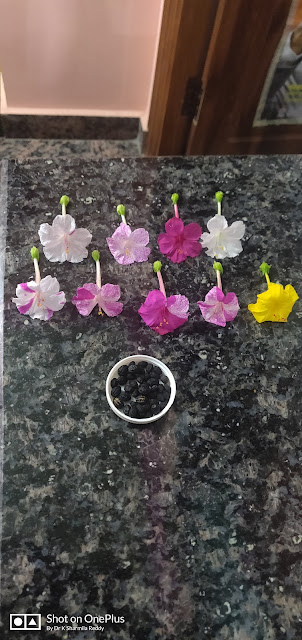


Another unique feature of Mirabilis
is its color changing phenomenon. A
plant on maturity changes the color of its flowers. Initially yellow can become
pink on maturity or vice versa.


Mirabilis has multiple uses. Its
flowers are used in food coloring and for dying textiles.
 In Peru, juice from
flowers is used to cure Herpes Lesions and Earaches.
In Peru, juice from
flowers is used to cure Herpes Lesions and Earaches.
 Its leaves are eaten as a vegetable.
Its bulbous roots have a laxative effect.
Its leaves are eaten as a vegetable.
Its bulbous roots have a laxative effect.


Mirabilis plants help in
Bio-remediation of heavy metals like Cadmium.


With varying colors Mirabilis serves as important source for genetic studies. Carl Correns used Mirabilis for his studies on Cytoplasmic Inheritance. Cross breeding of White Mirabilis Flowers and Red Mirabilis Flowers breed Pink flowers not Red, proving "Mendel's Law of Incomplete Dominance."


Very good information
ReplyDeleteBeautiful information I got...abt Chandrakant....
ReplyDeleteGood work. Varients are really very eye catching
ReplyDelete